Stairs wear out faster than any floor in the house, and the carpet that looks lovely in the bedroom is often the worst thing you can put on them. Here's what actually matters.
A stair carpet that's gone shabby while the rest of the house still looks fine is one of the most common reasons people start looking at a replacement. It's rarely a fault, and it's rarely bad luck. Stairs are simply the hardest-working surface in a home, and the carpet chosen for them is often the same one picked for a bedroom.
If you get three things right — the pile, the weight and the underlay — a stair carpet will comfortably outlast the guarantee. Get them wrong and you'll be looking at flattened, greyed-out treads within a couple of years.
Why stairs wear out so much faster
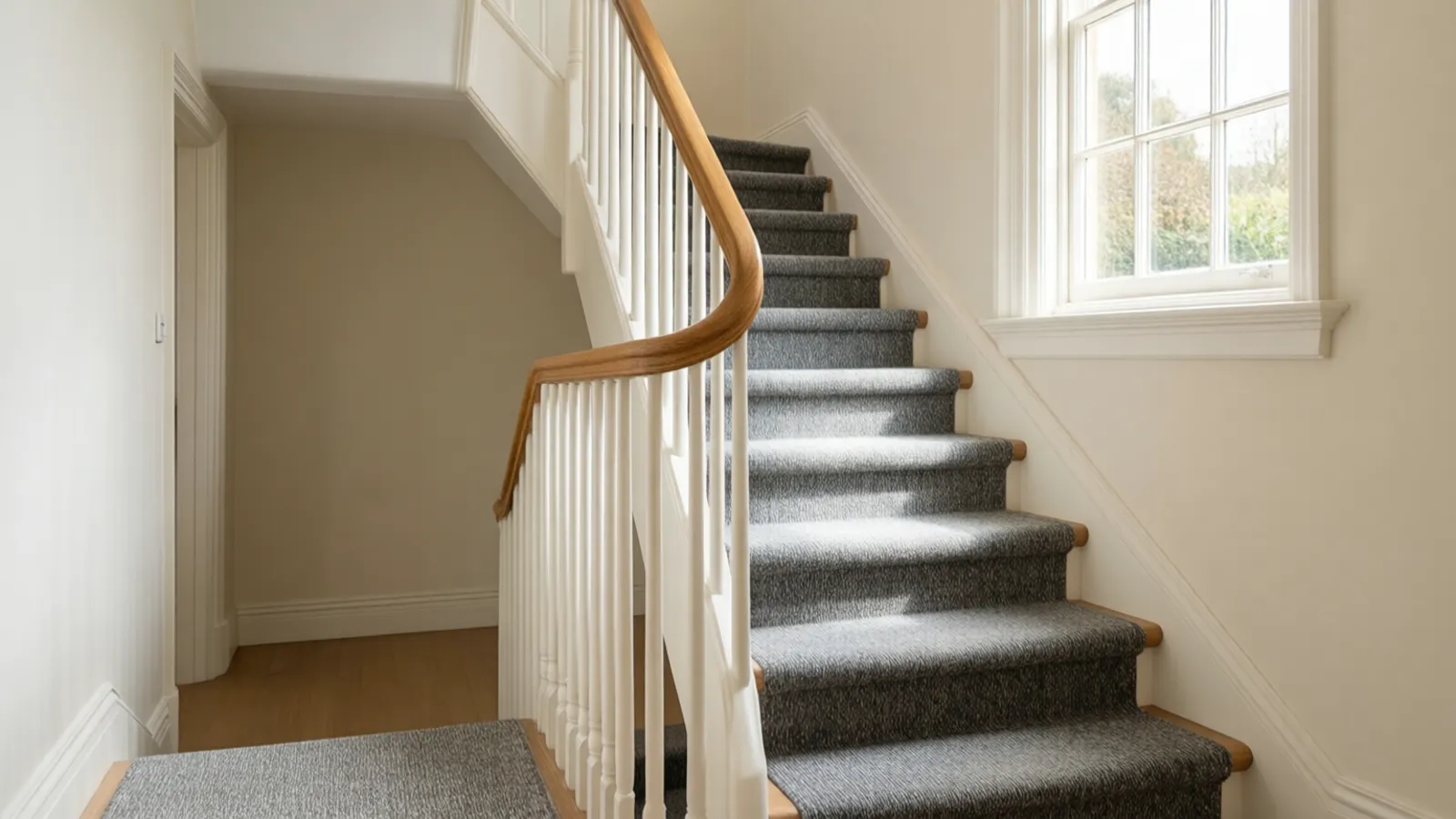
On a landing or in a lounge, your weight is spread across a broad area and footfall is scattered. On a staircase almost every step lands in the same place: the nosing, which is the front edge of each tread. That concentrates the entire load of the household onto a strip a few centimetres wide.
There's a second factor people forget. Stairs are usually the brightest-lit part of a hallway and you view them from above and head-on, so any crushing or shading in the pile is obvious in a way it never is on a flat floor. A carpet doesn't have to be worn out to look worn out.
Start with the pile — twist is the safe answer
Twist pile is the most popular carpet in the UK and there's a good reason for it. The individual fibres are tightly twisted and heat-set so they spring back rather than lying over. On a stair nosing, that recovery is everything — it's the difference between a carpet that looks tired and one that still looks like carpet.
A mid-tone flecked twist is about as forgiving as flooring gets. The fleck breaks up the surface so footprints, shading and the odd bit of grit don't announce themselves.
What to avoid on a staircase
- Long or shaggy piles. They look wonderful in a bedroom and dreadful on stairs within a year — the fibres are too long to stand back up once they've been crushed against a nosing.
- Loop pile and Berber on stairs with pets. Loops are hard-wearing underfoot, but a claw that catches a loop can pull a run right down the flight. On a flat floor this is far less of a risk.
- Very pale plain colours. There's no pattern to hide behind, and the nosings will shade before anything actually wears.
- Velvet and plain saxony. Beautiful, but they shade and show every footmark — on a staircase you see all of it at once.
Weight and density matter more than the price tag
Two carpets can cost the same and behave completely differently. What you're really paying for is how much yarn is packed into the backing. A denser carpet has less room for the fibres to lean over, so it holds its appearance far longer.
There's a simple test you can do in any showroom. Bend a sample back on itself, pile outwards. If the backing grins through easily, it's a loose construction — fine for a spare bedroom, not for a staircase. If you have to work at it to see the backing, that's the one you want on your stairs.
Underlay does more work on stairs than anywhere else
Underlay is where people try to save money and where it costs them most. On a staircase the underlay absorbs the impact of every footfall before it reaches the carpet backing. Skimp on it and you're grinding the carpet against bare timber hundreds of times a day.
For stairs you want a firm, dense underlay rather than a thick soft one. It sounds counter-intuitive, but a deep spongy underlay lets the carpet flex over the nosing every time you step, which breaks down the backing. Firm and dense supports the nosing and keeps the carpet stable underfoot — which also makes the stairs safer.
Plain, patterned or striped?
Patterns and stripes look superb on a staircase and they hide wear beautifully. They do come with a practical catch: they have to be fitted dead square, and every tread has to line up with the one below it. On a straight flight that's straightforward. Add winders — the wedge-shaped steps on a turn — and it becomes properly skilled work.
It also affects how much carpet you need. A patterned carpet has to be cut so the repeat matches across every step, and that means more waste. It's worth knowing before you fall in love with a design, because the quote will reflect it.
Two ways to fit a stair carpet
There are two common methods, and the right one depends on your staircase rather than your taste.
- Waterfall. The carpet runs straight down from the nosing to the back of the next tread without being pushed into the angle. It's quicker, it uses slightly less carpet, and it suits a plain modern staircase.
- Cap and band (upholstered). The carpet is pushed tightly into the angle where the tread meets the riser, so it follows the shape of every step. It takes longer and uses a little more material, but it looks far sharper on a traditional staircase and on anything patterned.
If your stairs turn, ask specifically how the winders will be handled. Well-fitted winders are the mark of a good stair job, and they're the first place a rushed fit shows.
A note on cost
Stairs cost more per square metre to fit than a plain room, and that surprises people. A rectangular bedroom is one cut and one stretch. A flight of stairs is a separate cut, fold and fix on every single step, plus the landing. The carpet itself might be the same price; the labour never is.
The way to keep the total sensible is to be realistic about the pattern and the shape rather than to drop down a grade of carpet. A hard-wearing plain twist fitted properly will serve you far better than a fancy pattern on a thin backing.
Come and feel the difference
You can read about density all day, but thirty seconds with two samples in your hands tells you more. Bring a photo of your staircase if you can — particularly if it turns — and we'll tell you honestly what will work and what won't. Have a look at our carpet range first if you'd like an idea of what's available.